Dante Audio Networking Best Practices for Multi-Stage Festivals
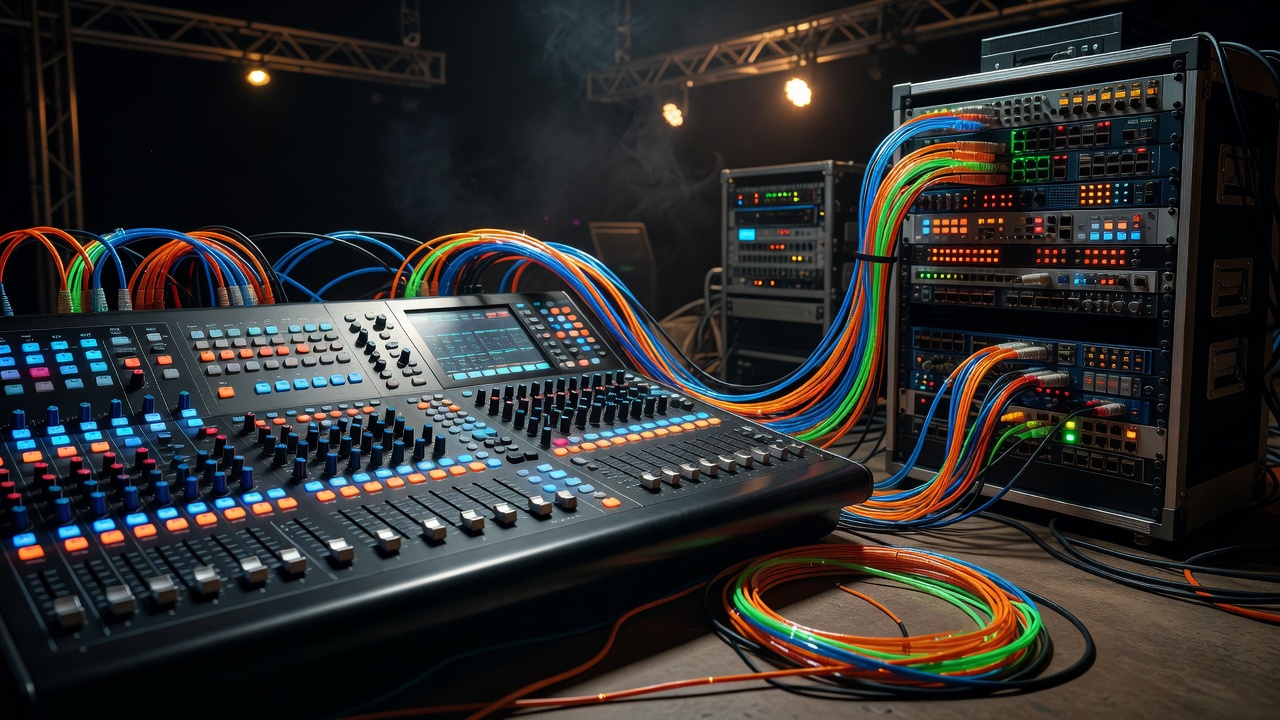
Introduction: The Shift to Gigabit Audio Infrastructure
Modern festival sound reinforcement relies heavily on Audinate's Dante digital audio protocol. Moving hundreds of channels of uncompressed 24-bit/96kHz audio over standard Ethernet cable reduces cable weight significantly compared to traditional analog multi-cores. However, network misconfigurations can lead to catastrophic audio dropouts or total system silence.
1. Managed Switch Configuration Rules
Unmanaged switches should never be used for critical tour infrastructure. When configuring enterprise managed switches (e.g. Cisco CBS350, Netgear M4250, Luminex GigaCore), enforce the following parameters:
- Disable Energy Efficient Ethernet (EEE / 802.3az): EEE puts Ethernet ports into sleep mode during brief lulls in traffic, causing severe packet drops and clock sync failure in Dante streams.
- Enable IGMP Snooping: Set IGMP Snooping to Active with an IGMP Querier configured on the primary core switch to prevent multicast audio traffic from flooding non-subscribed ports.
- Quality of Service (QoS): Enforce DSCP (Differentiated Services Code Point) tagging. Assign Clock Sync packets (PTP v1/v2) to DSCP 56 (Highest Priority) and Audio Packets to DSCP 46 (EF - Expedited Forwarding).
"A single unmanaged switch with Green Ethernet enabled inserted into a festival network can bring down an entire main stage secondary audio trunk."
2. Redundant Topology: Glitch-Free Seamless Switching
Dante supports true hitless redundancy through separate Primary and Secondary physical networks. Ensure that Primary and Secondary network switches run on isolated VLANs or distinct physical hardware stacks. Never cross-connect a Secondary port into a Primary switch interface.
Recommended Buffer & Latency Standards
For festival setups spanning up to 5 switch hops across fiber trunks:
- FOH to Stage Rack: 1.0 ms Latency setting
- Broadcast Stream Feeds: 2.0 ms Latency setting
- Clock Master: Dedicated hardware master clock (e.g., Soundcraft/DigiCo Console master clock or dedicated PTP master)